

By Clare Fuller, 12 July 2023
Advance Care Planning is something I care passionately about.
As a nurse specialising in Palliative and End of Life Care I have seen first-hand and too often what can happen if appropriate plans are not in place.
Advance Care Planning means thinking ahead, not waiting for a crisis and much of my work as an Advance Care Planning Consultant and Advocate is ensuring this message is heard.
One key element of Advance Care Planning that everyone should consider is making a Lasting Power of Attorney.
I attended an in-person hearing at the Royal Courts of Justice which addressed some of the challenges encountered by people making Lasting Powers of Attorney.
I’ll begin by explaining what a Lasting Power of Attorney is and the process every Lasting Power of Attorney will go through to become a registered document.
Then I’ll set out the background before moving on to describe the hearing.
I’ll end with an account of the judgment and close with how it might influence my practice.
1. What is Lasting Power of Attorney?
A Lasting Power of Attorney is a legal document that enables a someone (the donor) to nominate a person or persons (the attorneys) to act for them if they ever lose capacity to make decisions for themselves. Loss of capacity is often associated with a degenerative disease such as dementia, but can also occur as a result of a sudden accident or an acute ill health event. If more than one attorney is nominated, the donor must choose whether they will act jointly, jointly and severally or jointly for some decisions and severally for others.
There are two different types of Lasting Power of Attorney, one for Health and Welfare and one for Property and Finance. A Lasting Power of Attorney for Health and Welfare will enable decisions about things relating to care (see https://www.gov.uk/power-of-attorney)
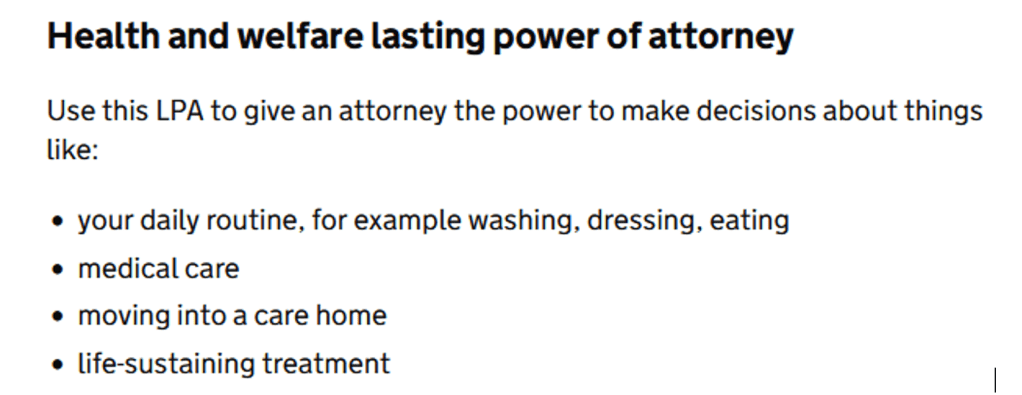
A Lasting Power of Attorney for Property and Finance will enable decisions relating to money and property. (see https://www.gov.uk/power-of-attorney)

A Lasting Power of Attorney can be created in three ways; a document can be created independently, with a Lasting Power of Attorney Consultant or with a solicitor, something I blog about in more detail here. A Lasting Power of Attorney can be created using paper forms or the on-line service from the Office of the Public Guardian. The on-line service means that the documents are created on-line but must be printed and signed as hard copies.
Whether a Lasting Power of Attorney is made on-line or by paper it has to be sent to the Office of the Public Guardian for checking and registration.
The checking process of a Lasting Power of Attorney
A Lasting Power of Attorney must follow correct process to become a legal document. This includes ensuring the details contained within it are accurate and lawful. The legal framework which applies to Lasting Power of Attorney is in section 9 of the Mental Capacity Act 2005.
A Lasting Power of Attorney application may be rejected by the Court of Protection, or the Court may rule that a part of the document is not valid.
The term “severance” is applied when a Lasting Power of Attorney is found to have invalid instructions. The Court removes or “severs” the invalid instructions so the Lasting Power of Attorney can be registered. (Click here for more information.)
The process of checking the lawfulness of and validating a Lasting Power of Attorney is completed by the Office of the public Guardian and takes approximately twenty weeks. Each application will progress through four distinct steps from waiting to processed.
This is an example of what can be seen when checking the progress of an application (applicable to on-line applications only).

An example of what a registered Lasting Power of Attorney looks like is provided by the Office of the Public Guardian and shown below.

Before writing in detail about the hearing I attended and the central theme of this blog, I will take a moment to highlight the process and the time it takes because many people believe a Lasting Power of Attorney can be created when it is needed. This issue was highlighted by Which? and something I raised awareness of in the blog Changing Fears to Facts.
As you need to have capacity to complete a Lasting Power of Attorney, it would be too late to complete when needed, or in other words when you had lost capacity. In the case of sudden accident there is simply no warning or time to begin a Lasting Power of Attorney. For some people, any delays can mean the window of opportunity to make a Lasting Power of Attorney could be lost.
The hearing I attended concerned nine Lasting Power of Attorney applications and the delays they are experiencing. The delays are happening because the Office of the Public Guardian and Court of Protection are wrestling with challenges in what I will describe as the logic, law and language in making a Lasting Power of Attorney.
2. The background to the hearing I observed
I was alerted to the hearing by Celia Kitzinger, co-director of the Open Justice Court of Protection Project. Celia had previously attended a previous on-line hearing in January 2023 to address challenges made to Lasting Power of Attorney applications, specifically whether what has been drafted by applicants is: “compliant with the law, i.e. does the Mental Capacity Act 2005 permit it.” You can read the blog ‘Test case’ on Lasting Powers of Attorney – with troubling delay which describes what happened and imagines what could constitute a concern .
Whilst the specific detail of the challenges was not set out in the hearing Celia attended, it appeared that questions had been raised by the Office of the Public Guardian.
Counsel for the Public Guardian, Neil Allen, said: “These LPAs have been carefully chosen by the Public Guardian as test cases to illustrate the legal issues requiring the court’s determination and guidance”.
In his opening summary he said that the people whose applications have been consolidated for this case “have either tried to create a lead attorney or provide for a majority rule or organise for the replacement of replacement attorneys. This raises validity issues, and whether any provisions need to be severed. There are over 100 similar cases which the Public Guardian is considering and will be affected by judgment in this case”.
‘Test case’ on Lasting Powers of Attorney – with troubling delay
In her blog, Celia states:
I don’t know the details of what the people whose forms are now before the Court of Protection were trying to do in their applications – but whatever it is, their forms have raised questions for the Public Guardian about whether what they want is compliant with the law, i.e. does the Mental Capacity Act 2005 permit it.
‘Test case’ on Lasting Powers of Attorney – with troubling delay
Celia continues to suggest what some of the concerns could be and writes:
I’m trying to imagine what people have done to cause the Public Guardian these concerns, and what that would look on the completed forms (which of course I haven’t seen). Maybe people have tried to complete the forms to achieve effects like these (examples invented by me!).
- “I appoint my three daughters, A, B and C as my attorneys to act jointly and severally but in any situation where they are acting jointly and they can’t agree, I want my daughter A’s decision to be final”
- “I appoint my three daughters A, B and C as my attorneys to act jointly and severally but in any situation where they are acting jointly and they can’t agree, I want the majority decision that any two of them agree on to be final”
- “I appoint my three daughters A, B and C as my attorneys to act jointly and severally, and my son D as a replacement attorney if any one of them becomes unable to act. If D is also unable to act, then I authorise A to choose another replacement attorney.”
- “I appoint my three daughters A, B and C to make decisions jointly and severally. Any decisions about life-sustaining treatment must be made jointly, and other decisions can be made severally. Decisions about where I live and am cared for must be made only by A, and decisions about my religious worship and diet must be made only by B.
These are entirely invented examples and I’ve no idea whether they accurately reflect the problems before the court. I will learn more (I hope) at the next hearing.
‘Test case’ on Lasting Powers of Attorney – with troubling delay
It is relevant to note that the applications in question were not “mistakes”, but that they were drafted in such as way that the lawyers could not confirm as would have legal effect in the way the donors seemed to intend.
The hearing I attended in April 2023 had been set as a directions hearing to explore the causes for concern and issues at the heart of the delays.
3. The hearing
I have attended previous hearings[i] as an observer however this was my first experience of attending in person. I arrived at the Royal Court of Justice in plenty of time to navigate the security checks and identify where the hearing was to be held. Other than the information available to me in the earlier blog I had no background to the hearing, this can make it difficult to pick up and quickly follow what is being discussed in Court. I was most grateful for Position Statements from Counsel for the Public Guardian Neil Allen, sent to me via email with the Transparency Order prior to the hearing, and the Official Solicitor Ruth Hughs for providing me with a Position Statement later in the day (both documents required anonymity to protect people at the centre of the hearing). A point of learning for me was to ensure connectivity to the Court of Protection Wi Fi before proceedings began as I found I was unable to connect and access the relevant email from Neil Allen until later in the day.
From the Position Statements I was able to gain a better understanding of the issues for consideration at the hearing which were:
A) Lead attorneys
(1) Whether it is lawful to give primary power to one attorney ahead of other attorneys
when appointed on a joint and several basis;
(2) Whether it is lawful to have joint and several appointments with instructions for
attorneys to deal with separately defined areas of the donor’s affairs or include
restrictions which have this effect;
B) Majority rule
(3) Whether it is lawful to instruct multiple (original or replacement) attorneys to act on
a majority basis;
(4) Whether ‘should’ or similar words constitute a binding instruction or a non-binding
preference on the part of the donor;
C) Replacement attorneys
(5) Whether it is lawful for the donor to replace a replacement attorney;
(6) If not, whether it is lawful for a jointly acting replacement attorney to be reappointed
to act solely.
The hearing began with Counsel for the Public Guardian Neil Allen setting out some background information. A summary of the key issues for discussion was provided which I found extremely valuable as at this point I did not have access to the Position Statements. For further context, Mr Allen informed the Court that there are “six million LPAs [Lasting Power of Attorneys] registered” and “five thousand applications are received per day. The vast bulk of which are entirely non-contentious.”
Discussion followed around the use of language and terminology which included:
- Donor (a person making a Lasting Power of Attorney)
- Donee (a person to whom authority is given to act on behalf of another)
- Attorney (a person to whom authority is given to act on behalf of another. This appeared to be considered more with Enduring Power of Attorney, which was replaced by Lasting Power of Attorney).
Mr Justice Hayden commented on the “archaic language” and reflected that it was not immediately accessible to members of the public. Some time and debate followed concerning the “obscurity of the language” and an agreement to use the word “donee” rather than “attorney”, however I noticed that the terms were used interchangeably during the hearing.
There appeared to be agreement between Counsel for the Public Guardian and the Official Solicitor on whether or not it is lawful for one attorney to be a “lead” when multiple attorneys are nominated to act jointly and severally. Common ground was agreed in stating that this was not possible to give “primary power” or lead to one attorney.
Regarding the second question, the Counsel for the Public Guardian and the Official Solicitor also agreed that answer is no, it is not lawful to have joint and several appointments with instructions for attorneys to deal with separately defined areas of the donor’s affairs.
Continuing his background information, Counsel for the Public Guardian stated, “as for majority rule, we are both of the view it ought to continue”.
Moving on to whether ‘should’ or similar words constitute a binding instruction or a non-binding preference on the part of the donor generated detailed discussion. The issue at heart here is section 7 of the Lasting Power of Attorney form which allows a donor to state any preferences or instructions. Section 7 includes the wording, “most people leave this page blank – you can just talk to your attorneys so they understand how you want them to make decisions for you.”
The example is from an existing Lasting Power of Attorney and one where nothing specific has been documented.

Instructions for completing section 7 can be found on LP 12, the guide to making a Lasting Power of Attorney:
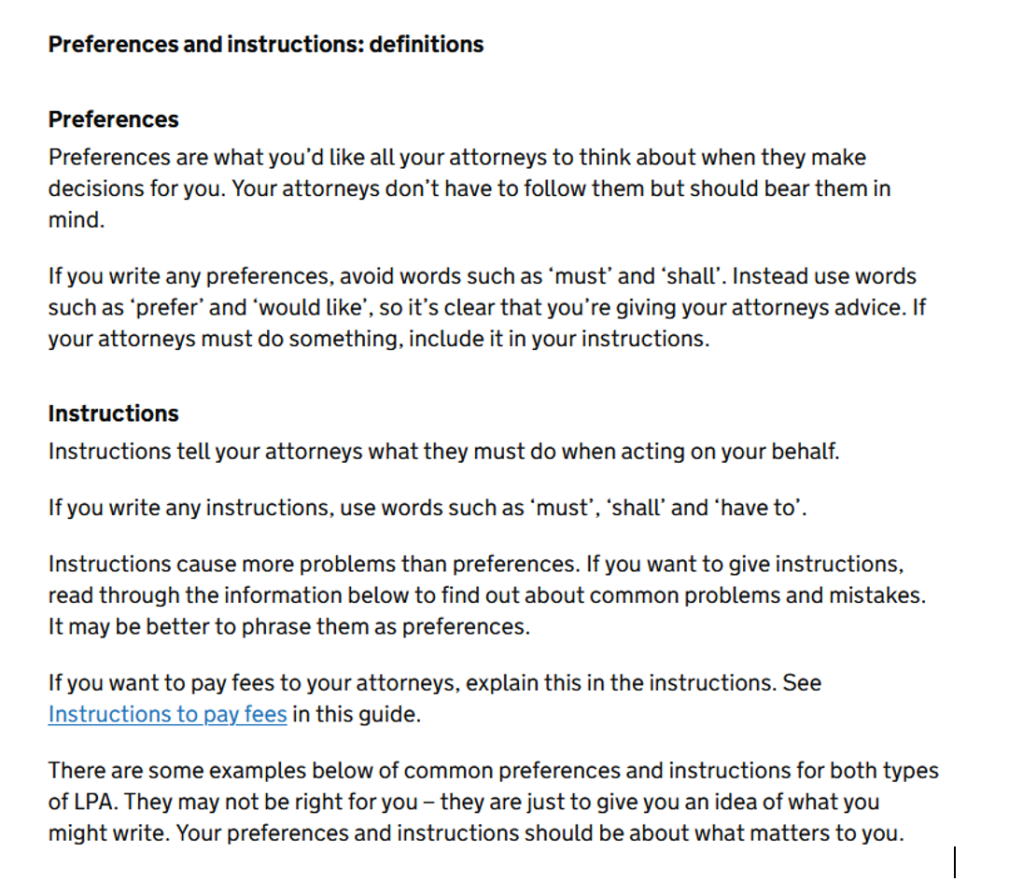
Here’s the link to view this information online:
Interpretation of language then followed, specifically the words “should and “must” and the implications of using these words in the preferences and instructions section. Later in the hearing, the Official Solicitor commented on the “mismatch between language and the forms.” I understood, from later discussion, that “conditions and restrictions” have previously been used in Lasting Power of Attorney instruments, and that the “forms were re-designed after user testing which called for simpler language” – but this simpler language has led to some tension between the forms and the statute.
I was struck by more potential confusion of language on a point that Mr Justice Haydon requested clarity on later in the hearing; namely the use of the letter “P”. The Mental Capacity Act states:
“A lasting power of attorney is a power of attorney under which the donor (“P”) confers on the donee (or donees) authority to make decisions about all or any of the following—
(a)P’s personal welfare or specified matters concerning P’s personal welfare, and
(b)P’s property and affairs or specified matters concerning P’s property and affairs,”
The interchangeability between the word donor and letter P was reflected on with Lord Justice Haydon stating: “It doesn’t help if we have a web of inaccessible nomenclature.”
Replacement Attorneys
Regarding replacement attorneys, this was described as the “meat” of the hearing. The decision being sought concerned whether a person making a Lasting Power of Attorney can make a successional replacement attorney. At present there is no space on the form to do so, a donor can choose to appoint an attorney(s) or replacement attorney(s); it would appear that donors have tried to use the existing form to express this wish.
Discussion followed regarding specific cases brought to the court and of previous hearings including Re Boff . Without background knowledge I found this part of the proceedings a little hard to follow, but what I have learned since from the archive records is Judge Lush “held that the meaning of s.10(8) MCA 2005 was clear and prevented the appointment of a further replacement attorney. A replacement attorney can only replace an original attorney.”
The judgment in Re Boff highlights the tension between guidance produced by the Office of the Public Guardian and legislation.
Leaving the hearing in April I felt mindful that, for some people, any delays could mean losing a window of opportunity to create a Lasting Power of Attorney. I found the discussion of great interest and had not before appreciated the tensions between logic, law and language in creating a Lasting Power of Attorney. A judgment was initially expected in July. As it turned out, however, judgment was handed down on 9th June 2023.
4. The judgment
A judgment for the hearing was released on 9th June 2023.
You can read it here: In the Matter of Public Guardian’s Severance Applications [2023] EWCOP 24
I will summarise my understanding of the key points and outcome below.
The judgment acknowledges the number of Lasting Power of Attorney applications that the OPG receive every day (between 5,00 and 6,000). When the Mental Capacity Act came into law in 2005 there were fewer than 10,500 applications for an entire year.
Acknowledgement is made of the situation each case presented, and that the nine cases were representative of enough similar cases for the OPG to request clarity.
The points the OPG requested clarity on were situations relating to lead donees, majority rule and replacement donees.
The mismatch between the language and the LPA has previously triggered judicial comment to the effect that ‘it may be that those responsible for drafting forms will wish to reconsider these changes’. (Re Public Guardians Severance Applications (2017 EWCOP 10. Hayden J repeated this concern, saying that, “The donor who constructs their instructions around the language of the forms, rather than the language of the statute, risks invalidating the LPA altogether” and “The words of the form may become a siren voice dragging the donor’s preferences onto rocks which prevent the instrument from operating as a valid, lasting power of attorney” (#42).
- With regard to lead donees, Justice Hayden held that primary power cannot be given to one donee ahead of others (when donees are appointed jointly and severally). He held that primary power cannot be given to one donee ahead of others when appointed on a joint and several basis. He noted that if a donor appoints more than one attorney on a joint and several basis, then equality prevails
- Whether it is lawful to have instructions for jointly and severally appointed donees to deal separately with different remits of responsibility (e.g. requiring a jointly and severally appointed attorney to make decisions only relating to, for example, ‘my business affairs’ or ‘my personal affairs’) was declared more challenging. Mr Justice Hayden held that the current wording of the statutory provision does not support such interpretation and acknowledged the “dangerous” divergence between language of the statute and wording on the forms. That said, Mr Justice Hayden recognised that there is nothing to prevent the donor from creating two LPAs, each appointing an attorney to deal with certain powers.
- Regarding the issue of majority rule, Justice Hayden declared that this is inconsistent with statutory provision. There was consideration whether a purposive approach to interpretation of the statute could be legitimate; however, he stated:
“Ultimately, however, I cannot conclude that it is, without compromising the logical
integrity of my earlier analysis. The provisions of Section 10(4) are drafted so tightly
that they leave very little, if any, scope for a purposive approach.”
- Interpretation of the word “should”, Justice Hayden declared was case specific. For the case of Ms B, (one of the cases brought for consideration), Justice Hayden could not see grounds for severance.
“The word ‘should’ is defined as ‘suggesting that something is the proper, reasonable, or best thing to do’. I recognise that this does not sit comfortably within the wording of Section 10 because it is potentially ambiguous. Unfortunately, the form poses a number of alternatives, the first of which is expressed as “decisions attorneys should make jointly” (my emphasis).”
He continued:
“I am not intending to signal any wider guidance as to how the word ‘should’ is to be interpreted. It is highly fact specific and its significance and force will be dependent on context. I am, however, signalling that its use will not automatically give rise to severance. It is the wording on the forms that generates the ambiguity.”
- On replacement attorneys, Mr Justice Hayden ruled that a donor is entitled to choose an attorney to replace a replacement attorney. He accepted that section 10(8)(b) MCA 2015 was slightly ambiguous but also added that this section states a secondary replacement attorney is allowed and “a scheme which prohibited the appointment of a secondary replacement might, equally logically, conflict with the objectives of the legislation.” He decided he was “satisfied that an interpretation which permits the appointment of a secondary replacement attorney, is to be preferred.”, explaining that the MCA 2015 requires that the choice of donee is always to be that of the donor in line with promotion of autonomy.
Mr Justice Hayden closes his judgment recognising the potential for “legislative amendment,” and an awareness that this will not be possible in the “near future”. But “the clarifications required to the LPA forms do not, as far as I can see, provide quite the same difficulties. The amendments that they require are limited in scope and ought easily to be manageable.”
5. Making sense of the judgment
In section 2 of this blog post, I wrote about the background to the hearing and I quoted Celia Kitzinger’s imagined examples of the kinds of dilemmas the OPG was facing from would-be donees.
Drafting this blog, with the benefit of the judgment has provided an opportunity to revisit the imagined examples, and time for both Celia and me to articulate how we have interpreted the judgment. I am going to return to the examples now and offer our views alongside an invitation to lawyers for commentary.
I’ll reproduce the examples again, followed by our view in light of the judgment.
1. “I appoint my three daughters, A, B and C as my attorneys to act jointly and severally but in any situation where they are acting jointly and they can’t agree, I want my daughter A’s decision to be final”
Our understanding, in the light of the judgment, is this would not be permitted and would be severed. It’s Qi (‘Primary power”) addressed in the judgment: “It is clear that if a donor appoints more than one attorney on a joint and several basis, it must be understood that equality prevails. Thus, a provision such as “in the event of disagreement, A is to defer to B” or “B’s decision will be final” is irreconcilable with the phrase “jointly and severally” (§39). This appears clear, no one donee has greater power than another.
2. I appoint my three daughters A, B and C as my attorneys to act jointly and severally but in any situation where they are acting jointly and they can’t agree, I want the majority decision that any two of them agree on to be final”
Once again, we understand that thiswould not be permitted and would be severed. It’s (“Majority rule”) Qiii addressed in the judgment. Hayden reluctantly says this isn’t allowed at §45: “Before me, both Mr Allen and Miss Hughes agree, that a ‘majority rule’ provision, as they have termed it, must be severed as they contend that it is inconsistent with the statutory provision. Though they are agreed on the point, I have, as with the previous issue, considered whether a purposive approach to the interpretation of the statute might be legitimate. Ultimately, however, I cannot conclude that it is, without compromising the logical integrity of my earlier analysis. The provisions of Section 10(4) are drafted so tightly that they leave very little, if any, scope for a purposive approach. This said, I find myself sympathetic to the frustration effervescing in DJ Eldergill’s judgment.” (§45). We understand that a majority rule approach will be severed.
3. “I appoint my three daughters A, B and C as my attorneys to act jointly and severally, and my son D as a replacement attorney if any one of them becomes unable to act. If D is also unable to act, then I authorise A to choose another replacement attorney.”
Our interpretation of the judgment, in this too is not permitted. It is permitted to appoint a replacement attorney (D in the example above) – but not for the donor to attempt to authorise a donee (A in the example above) to choose a successor replacement donee if the replacement donee nominated by the donor is unable to act. This would be severed as inconsistent with statute. Section 10(8) prohibits the donee from appointing a substitute or successor: “The MCA requires that the selection of the donee is always to be that of the donor. That is consistent with the promotion of autonomy. Any selection of a donee by an existing donee is expressly prohibited because that is not consistent with promoting the autonomy of the incapacitated person. It takes decision making entirely out of the donor’s hands” (§52). However, the donor could say: “If D is also unable to act, then I want E to be my replacement attorney instead“ – because E would be a “replacement replacement attorneys” and our understanding is that it is permitted for a donor to have “replacement replacement attorneys” in a Lasting Power of Attorney.
4. “I appoint my three daughters A, B and C to make decisions jointly and severally. Any decisions about life-sustaining treatment must be made jointly, and other decisions can be made severally. Decisions about where I live and am cared for must be made only by A, and decisions about my religious worship and diet must be made only by B.“
In Celia’s final example the question of whether attorneys can make some decisions jointly and others jointly and severally is posed. We both found this one more challenging to interpret and welcome commentary, here are our thoughts. This relates to Q (ii) in the judgment: “Whether it is lawful to have joint and several appointments with instructions for attorneys to deal with separately defined areas of the donor’s affairs or include restrictions to this effect“. We believe the answer in §41 is that this can’t be done – but that maybe (maybe?) the donor can achieve this using two separate LPAs. Adding complexity, we note from LP12 Make and register your lasting power of attorney: a guide that the following information is given.
Health and care LPA examples:
If you choose ‘jointly for some decisions, jointly and severally for other decisions’, you should make a statement like one of these on Continuation sheet 2:
My attorneys must act jointly for decisions about where I live and may act jointly and severally for everything else.
My attorneys must act jointly for decisions I have authorised them to make about life-sustaining treatment and may act jointly and severally for everything else.
We think, therefore, that the first part would be permitted (“I appoint my three daughters A, B and C to make decisions jointly and severally. Any decisions about life-sustaining treatment must be made jointly, and other decisions can be made severally”) but that the second would not be permitted (“Decisions about where I live and am cared for must be made only by A, and decisions about my religious worship and diet must be made only by B”. )
I am happy to admit that following some of the logic, law and language of the judgment has been hard at times and I still am not sure if I completely understand all elements of the judgment. I am looking forward to reflections and commentary from lawyers to check my understanding.
How this will influence my practice
I am grateful for the opportunity to attend the hearing and see first-hand the challenges of law and language that are wrestled by the Office of the Public Guardian and the Court of Protection. I have gained greater confidence in answering clients’ questions as a result, e.g. since attending the hearing a number of clients have asked about appointing “lead attorneys”, for example, and I can tell them with certainty that this is not possible.
I have observed in my recent discussion with clients an assumption that some attorneys carry more weight than others, typically a spouse for example, above children. I note from the language people use such as “the main” or “the first,” that there can be a tendency for people to think, erroneously, that the order in which they document attorneys carries meaning. Attending the hearing gave me an opportunity to learn about some of the tensions that can occur in the wording of a Lasting Power of Attorney; I also have greater understanding of dilemmas that people can wrestle with in creating these important forms.
Reflecting honestly on how comfortable I feel drafting documents with replacement of replacement attorneys, I can see how that would be drafted in the LPA however would still feel anxious about submitting to the OPG. I feel I understand the principle but am mindful of the caution on the form “the more specific the instructions, the greater the chance that they will not be able to be followed.”
Regarding separate LPAs to address separate issues, this is something I would like to have greater understanding of. The divide between Health and Welfare and Property and Finance is easily comprehended and to draft a Business LPA to deal with business rather than domestic assets also makes sense; I am less clear how multiple or sequential Health and Welfare LPAs would work. Overall, attending the hearing has been an interesting and highly informative experience. Seeing the challenges of applying existing law to current forms highlighted pitfalls I hadn’t previously been aware of and gave me a greater understanding of the logic, law and language associated with making a Lasting Power of Attorney. There remain, however, some elements of uncertainty for me.
Clare Fuller RGN MSc is a registered nurse with a career dedicated to Palliative and End of Life Care. She is an advocate for proactive Advance Care Planning and provides EoLC Service Improvement and bespoke EoLC Education. Clare hosts the weekly podcast Conversations About Advance Care Planning. She is also a Lasting Power of Attorney Consultant and director of Speak for Me . Connect with Clare on Twitter @ClareFuller17
[i] Previous hearings I’ve blogged about are:
Bearing Witness: Anorexia Nervosa and NG Feeding;
Lasting Power of Attorney: Across Borders
Capacity to make a Lasting Power of Attorney
Reflecting on Re MW and Advance Planning: Legal frameworks and why they matter
What happens when Lasting Power of Attorney goes wrong?
Decision-making with clarity and compassion: Validity of LPAs and appointment of Deputy


One thought on “The logic, law and language of Lasting Power of Attorney: A case before Hayden J”